
Real or Not: An Academic Paper on (Maybe) the World's First Axe Murderer
And how—SURPRISE!—it may have subconsciously inspired a sizeable portion of Roxi Lovegood's character in ✨Song of the Sidhe✨

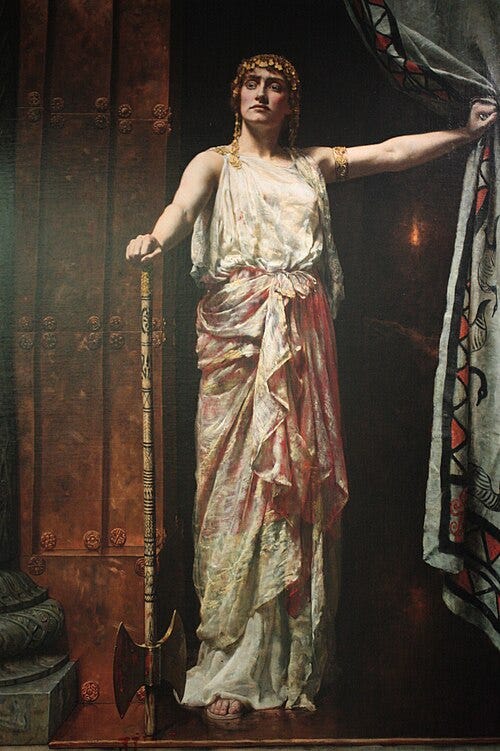
Klytemnestra took an axe
and gave her husband forty whacks
When she saw what he had done
She figured, “Why not forty-one?”
Introduction
Does this article have anything directly to do with my upcoming novel or its series?
No.
Is it the paper I wrote as a “practice thesis” while in grad school—and the source of the research that greatly inspired the Fomorians of Song of the Sidhe?
Yes.
I’ll write a whole different article about Roxi Lovegood, the Fomorians, and how/why their whole arc connects to the very real Sea Peoples of our very real ancient history because it’s definitely a fascinating topic I think we don’t look at closely enough. Since I’m planning on seeing the new Christopher Nolan film, The Odyssey, this coming weekend, I’ll probably be super pumped afterwards and smash out a whole thesis on Pages to publish in here.
The reason why I’m sharing a college paper in the middle of fine-tuning edits and revisions for the upcoming third installment of my series, Queen of Night, is twofold:
People asked for it after I posted my personal favorite observation/theory around the aftermath of the Trojan War (asked, demanded, same thing!)
When I finally dug it up out of my archives and read it again after almost a decade of shoving it away (professor’s feedback was not…encouraging…), I was struck by the subconscious parallels I’ve been drawing this entire time between Roxi Lovegood—the main protagonist of Song of the Sidhe—and Klytemnestra.
I swear, it was completely unintentional.
While it still may be a bit too soon to go into great detail of how/why/where those parallels are (no spoilers, I promise!), I think it’s safe to say for the readers just now discovering the first book, Ithandryll, that a strong sense of injustice clings to Roxi even as she pushes forward to live her best life despite everything she left behind as of Page One, Paragraph One, Chapter One.
Those who wronged her got away with it.
The crimes committed against her were shrugged off by those who should have sided with her.
She’s expected to shake it off, move on, let it go.
Even though the nightmares persist, the pain still throbs in her soul, and she’s forced to struggle to survive while the man who made her life a living hell is out there skippideedoodaa-ing around without a care in the world.
Why should he care? No one ever held him accountable.
These are the exact same conditions the character, the person, of Klytemnestra had to endure throughout the entirety of her adulthood.
The man who murdered her husband and children, then stole her away and forced her into a new marriage—to himself—got away with it. No one held him accountable for his crimes. No one stopped him or chastised him when he sacrificed their daughter to the gods “for favorable winds”.
Read that again: he murdered his own child not for success at retrieving his wayward sister-in-law or victory over the Trojan military forces.
Favorable winds.
Klytemnestra was expected to endure her grief quietly, privately, but ultimately shake it off by the time Agamemnon returned 10 years later because “it’s all in the past”.
Move on, let it go, and celebrate the return of the man who slaughtered your whole family who’s now brought home a captive slave to be his new mistress.
It’s fine.
Everything’s fine.
*Eye twitch*
Just as I did not expect to find so many connections between different parts of the world while chugging Mountain Dew Code Red at 2AM with five books open simultaneously across a table—sticky notes everywhere—I definitely did not expect to discover (or perhaps rediscover?) so many connections between who some historians have titled “The World’s First Axe Murderer”, the kickass-but-vulnerable main protagonist of my award-winning modern epic romantasy…and myself.
Which ultimately brings me back around to why I think it’s important we look at, discover, and remember Klytemnestra: I’m not reaching for my Minoan battle axe and neither should you be, but I think we can agree that we understand her. In so many ways (especially if you’re a woman), we are her. We know what it is to silently grieve when the world demands we rejoice; we know how it feels to be gaslit into acting like—or even believe—that those who committed heinous crimes against us did nothing wrong. “That’s just who they are.”
And hey, there’s a bonus to reading my caffeine-fueled, half-shod attempt at figuring out how to write a thesis:
You’ll get the deep lore behind Agamemnon that the movie doesn’t cover but 100% will make you go, “OOOOOHHHHHhhhh… Okay, yeah. He kinda makes sense now.”
{Bibliography is at the bottom; I couldn’t figure out how to use footnotes on this platform.}
“How long will you hide
oh queen of the night?
How long will you shudder
when you should fight?”
The third book in the award-winning modern epic romantasy series is around the corner—and right now is the perfect time to join the official Advance Reader Copy (ARC) team!
Members of 🍄The ARC Circle🍄 enjoy:
FREE admission
FREE digital copies of Ithandryll (Book 1) and Heir of Oberon (Book 2)
ARCs for each upcoming book in the Song of the Sidhe series
First Access to promotions on paperbacks and special editions
Exclusive Access to the private Discord server
Gifts & Goodies from the author (me!) like digital stickers, letters from the Otherworld, and more!
✨🌙ARCs for Queen of Night will be distributed mid-August✨🌙
Klytemnestra: Motherhood, Murder, and the Birth of the Judicial Court
Centuries after Homer wrote The Iliad and The Odyssey, an Eleusian warrior and playwright by the name of Aeschylus wrote over seventy plays of which only seven survive today. Three detailed the accounts of Agamemnon and the aftermath of the Trojan War. This particular trilogy, The Oresteia, followed the oral traditions of Athens, Sparta, and their tribal predecessors of Mycenae in retelling the story of Agamemnon’s wife, Klytemnestra, and the tragedies that drove her to brutally murder the king of Mycenae the same day he returned from Troy.
Given the long expanse of time between Aeschylus’ life and the events of the Mycenaean empire, Klytemnestra has long been classified as a mythological character utilized in ancient and modern literature to embody both cold-blooded matricide and the plights of women trapped in cycles of abuse and misuse by men of power. She is both villain and hero, conniving and suffering, and interpretations of her actions have varied between male and female perspectives in literary analysis.
Yet the question remains: was Klytemnestra real? Did Agamemnon, of whom archaeologists have found much by way of tangible evidence, truly have a wife who murdered him in his own bath? Or was he killed during a feast at the hands of Klytemnestra’s lover, like Homer originally portrayed in The Odyssey? And in the face of scandal such as initial archaeologist Heinrich Schliemann was over his findings at Mycenae, what does the archaeological record truly say?
Whatever the specifics of Klytemnestra may be, there is no contention over the impact of her life—and death—on the structure of the Athenian court of law. A system of testimony, judicial delegation, prosecution and defense, exampled by both mythological and historical characters in Oresteia, developed out of Aeschylus’ writings to form the same legal system that exists today in the United States of America and other Western nations. It is important, then, to not only examine the cultural interpretations of the woman, wife, and mother that was Klytemnestra, but also to investigate the reality of her existence in ancient history.
Through reviewing the mythos surrounding Klytemnestra and Agamemnon, the life and political atmosphere of Aeschylus in Athens, archaeological sites and evidence, the weapon(s) used by Klytemnestra, and the overarching purpose of her story, one may find the keys to understanding the complexity of the woman who not only inspired the formation of modern court, but acted as a catalyst to the ultimate downfall of Mycenae.
The Mythos of Klytemnestra and the House of Atreus
The founder of the House of Atreus was Tantalus, king of Phrygia, who wed Dione, daughter of Atlas, and through her fathered two sons, Pelops and Broteus, and one daughter, Niobe. Myth traditions in the region of Phrygia center on Tantalus and Niobe, citing Tantalus’ crimes as the cause for the earthquakes and chasms that destroyed the city of Tantalis. Diodorus places Tantalus’ dominion over the area between Sipylus and Ida.
According to legend, Tantalus was invited to dine with the gods and—in an effort to honor them—sacrificed Pelops with his own hand. He then boiled his own child’s flesh and served it as a meal to the gods, who quickly realized what had transpired and refused to eat the meat.
All except Demeter, who was so distraught over the loss of her daughter Persephone that she did not pay much attention and accidentally nibbled on a piece of Pelop’s shoulder.
The gods gathered the pieces of Pelops and restored him to life. As punishment they threw Tantalus into Tartarus and cursed him to hunger and thirst for all eternity. No matter how close to food or water he could get, the waters would recede and the food lay just barely beyond his fingertips. Relief would forever be out of reach.
Pelops grew and married Hippodameia, with whom he fathered two sons: Atreus and Thyestes. The brothers became rivals in adulthood; after banishing Thyestes for seducing his wife and attempting to claim the throne, Atreus invited him back for a feast of reconciliation. The main course was Thyestes’ own sons, cut up and boiled in a similar fashion as Tantalus had done with Pelops. In a rage, Thyestes cursed Atreus’ house to be “self-devouring” and fled.
During his exile, Thyestes sought an oracle for advice on how to wreak vengeance on his brother, and was told that a son by his daughter Pelopia would grow up to kill Atreus. On a night when Pelopia performed an animal sacrifice to the gods, Thyestes attacked, raped and impregnated her as she bathed in the river. Ashamed of what happened, she abandoned her newborn in a field, where he survived by suckling from a goat until he was found by local shepherds and named Aegisthus (which means, “male goat”). The shepherds took the infant to Atreus, where he was welcomed and raised as one of the king’s own sons. No one recognized the true family relations between them or Atreus’ new wife, the very same Pelopia. She gave Aegisthus the sword of her rapist, which she had managed to steal during the attack in order to later identify the man.
When Atreus’ sons Agamemnon and Menelaus captured Thyestes, Aegisthus was sent to deliver the execution. Thyestes immediately recognized his own sword and asked where the young man found it; when Pelopia was questioned, she realized her rapist was her own father. Overcome with agony and despair, she threw herself upon his sword and died. Aegisthus turned away from Thyestes and instead killed Atreus, then claimed for himself and his father the land and titles that they had lost during Thyestes’ exile. Father and son jointly ruled over Mycenae and sent Agamemnon and Menelaus into exile to Sparta, where the House of Tyndareus welcomed them.
Tyndareus was the son of Oebalus and Gorgophone, and the king of Sparta. He married Leda, the princess of Aetolia, and with her had seven children: Castor, Klytemnestra, Timandra, Phoebe, Philonoe, Helen, and Pollux. Helen and Pollux were suspected to be the children of Zeus, who had disguised himself as a swan and seduced Leda.
NOTE: Some oral traditions claim all of Leda’s children to be Zeus’, while other traditions claim half came from Tyndareus. All versions include the laying of eggs from which children emerge, whether just Helen and Pollux from one egg, or all the children born from two eggs.
During a sacrifice to the gods, Tyndareus forgot to include Aphrodite in his worship. As punishment, the goddess cursed his daughters to be wed multiple times and obtain the reputation of husband-abandoners, despite whatever circumstances may have existed to cause the betrayals and remarriages. Timandra was the first daughter to leave her husband, Echemus king of Arcadia, for Phyleus king of Dulichium.
Mythos traditions do not give a specific reason for Timandra’s infidelity, unlike her sisters.
Agamemnon and Menelaus were guests of Tyndareus for many years, and when his daughters were of age, Helen was given to Menelaus in marriage. Klytemnestra married Tantalus II, son of Broteas, and with him bore a son. Soon after this, Agamemnon murdered Tantalus II and the infant, took Klytemnestra for his wife, and returned to Mycenae where he swiftly regained the throne and established himself as king. After this time, he fathered with Klytemnestra Iphigenia, Electra, Orestes, and Chrysothemis. When Helen left Menelaus for Paris of Troy, Agamemnon gathered the armies of Mycenae and started the campaign against Troy to avenge his brother’s honor.
Before departing from a port in Boeotia, Agamemnon somehow offended the goddess Artemis and incurred her wrath. Sources are unclear as to what specific action caused the offense towards Artemis, only that she was displeased by Agamemnon’s greed and violent ambition on the whole. Plague, lack of wind, and other misfortunes drove Agamemnon to desperation, and at the advice of the oracle Calchas, he sacrificed his daughter Iphigenia to Artemis (according to the accounts found in Cypria, part of the Epic Cycle which chronicles the Trojan War). Misfortunes eased, and the Mycenaeans could finally leave Boeotia for the shores of Troy.
While Agamemnon was away at war for over a decade, Klytemnestra took as her lover Aegisthus, the very same son of Thyestes. Upon his return from Troy, Agamemnon easily dismissed Aegisthus and assumed his wife was overjoyed to welcome him home, even as he brought in his Trojan captive and new mistress, the seer and Trojan princess Cassandra. Despite Klytemnestra’s covert attempts to lure Agamemnon into dishonoring himself in front of his men and the gods, his own hubris prevented the mishaps.
In one such instance, Klytemnestra had purple linens—the fabric of the gods—unrolled at Agamemnon’s feet upon his return from Troy and urged him to step on them. Had he done so, he would have disgraced himself in front of his subjects and angered the gods, lending more sympathy to his impending death. Instead, Agamemnon laughed at her lavishment and stepped around them in a move meant to equate himself with his surviving warriors of the war.
Cassandra envisioned what was about to happen and warned Klytemnestra of the consequences, but the queen ignored her and made her work as a servant in the royal house.
While Agamemnon bathed in his chambers, Klytemnestra threw a blanket over him to entangle his limbs in the water and prevent his escape. She then stabbed—or hacked—him to death. She murdered Cassandra as well, then married Aegisthus to jointly rule over Mycenae.
(This version of the arrival and murder of Agamemnon is from Aeschylus’ The Oresteia; a slightly different version such as that found in Sophocles’ Elektra depicts Aegisthus aiding Klytemnestra in the murder, and a net is used instead of a blanket.)
Despite his love for his mother, Orestes felt troubled by the murder of his father and subsequently killed Klytemnestra. Aeschylus’ account in Oresteia describes Orestes enlisting the help of his sister, Elektra, and his friend, Pylades, to carry out the murders at the order of the Oracle at Delphi.
He also killed Aegisthus and any children born between the couple. Variations between Aeschylus, Sophocles, and other versions indicate at least one possible child, and up to three or four.
This act only heightened Orestes’ guilt over the crimes of his family, and he fled to Delphi where he was constantly plagued by the torments of his mother’s erinyes (an ancient goddess of vengeance, most often in relation to familial crimes; in some uses the word refers to a person’s “vengeful spirit/ghost” and is also interchangeable with Fury/Furies). When protection could not be found at the temple of Delphi, he moved on to Athens, where the goddess Athena received him on the acropolis and held a trial for him before twelve judges, with herself included among them. Since Orestes had apparently acted upon the orders of Apollo and delivered justice for murder, he was acquitted and freed from his tormentors.
Weapon of Choice
An interesting area of study in Klytemnestra’s murder of Agamemnon has been that of her weapon of choice: was it a sword or an axe?
Literary analysis examines this as an artistic choice between a phallic symbol (the sword) and a weapon traditionally used by women in Minoa and Mycenae (the axe). Feminist historian Barbara Walker theorized that the double-headed axe, or labrys, was a weapon used as a scepter by the Amazonian goddess Rhea until male priesthoods overran the citadel at Delphi and shifted the image of the axe from female to male iconography. Anthropologist Marija Gimbutas “connects the labrys to the shape of the butterfly (and the bee), which figured the female capacity for (re)generation”. This would suggest not only Klytemnestra’s proclivity towards using the labrys out of heritage and habit, but also hints at the remnants of Minoan culture which still existed in Mycenae—a culture that, other feminist historians argue, could have been largely matriarchal instead of patriarchal as was previously assumed.
Other aspects of Klytemnestra’s vengeance upon her husband point out Aeschylus’ likening Agamemnon to animal imageries heavily attributed to Minoan culture: a bull “struggling in the net…connected with a sacrificial ritual, a bull-sacrifice”, and a snake whose “head is the most natural and obvious part…at which to aim a blow”. In the first play of Aeschylus’ trilogy, Agamemnon, Klytemnestra described her methods as using both weapons to deliver the fatal blows:
“Then, at my leisure, choosing the best places
On his helpless body
I pushed the blade into him. Once, twice.
Twice he screamed. You heard him.
Then his eyes stared elsewhere.
His body arched like a bow being strung,
Every muscle straining for life.
I placed the point for a third and final time
And drove the blade clean through him.”
G.C.W. Warr viewed this passage as a clearly marked confession to changing weapons mid-attack: Klytemnestra “first cut him down with two blows of the axe falling on the head, which was an easy mark; then, when he was down and at her mercy, she finished him with one thrust of the sword of Aegisthus”.
Significant as well is the total exclusion of the sword in the accounts written by Sophocles and Euripides, who instead adhered to the traditional use of the labrys both as a nod to previous versions and, quite possibly, to underline the importance of Minoan heritage in the Mycenaean past. Whether intentional or not, this constant referral to Minoa also underlines the seize of power Klytemnestra took as the woman of her household, using the feminine labrys to cut down the murderer of her first husband and two of her children when no other justice was in sight.
It was this idea which Klytemnestra used as her defense when confronted by the Chorus, reminding them that while she would be held accountable for her actions against Agamemnon, no one held the king of Mycenae accountable for the blood of their daughter on his hands:
“Where were they, and where were you
When this monster here
Butchered his own daughter on the block?
He found it easier
Than sacrificing one of his precious cattle to butcher my daughter—
Like somebody else’s goat…
Why didn’t you judge Agamemnon?”
It seems fitting for Klytemnestra, a woman whose anger burned against Agamemnon for sacrificing Iphigenia like livestock, to kill him in the manner typically utilized for capturing and butchering cattle—doubling insult to injury by conducting the murder at Agamemnon’s most vulnerable point of the day.
Homer even inferred such emasculation in The Odyssey, whose Agamemnon recounted a very different and public version of his death to Odysseus during the latter’s journey through the Underworld: “The great king is slaughtered side by side with his etaipoi… Homer characteristically gives Agamemnon as heroic a death as is possible and eschews the frightening, sordid, and doubtless original tradition of the helpless unarmed king struck down in his bath”.
Homer also inferences the death of Agamemnon to be at the hands of Aegisthus, a man, rather than his wife.
In this scenario, it is Aegisthus who personally delivers the fatal blow and in public view where Agamemnon stood a chance to fight back or gather defensive forces. (In Aeschylus’ version, as well as several other versions of the story, Aegisthus is either noticeably absent from the scene or passively helps Klytemnestra restrain Agamemnon.)
That a woman caught him naked and vulnerable in his bath, literally and figuratively with her net, then hacked into him with her own furious strength, first with axe and then with sword, is not something one king would readily admit to another. Instead of admitting his own faults and grievous errors made in life, Agamemnon simply warned Odysseus of the dangers of treacherous women.
Aeschylus, Athens, and the Oresteia
The tragic poet Aeschylus wrote the vast majority of what is known about Klytemnestra in his play, The Oresteia, with subsequent accounts by later authors built upon Aeschylus’ work (or at least heavily referenced to it).
Born in 525 BCE in Eleusis, he was the son of Euphorion and one of five children in the household. Life, the prefix to the Medicean manuscript of Aeschylus’ plays, states that he and his brother Cynegeirus fought against the Persians in the battle of Marathon, alongside his youngest brother Ameinias in the battle of Salamis, and later in the land battle of Plataea.
While writing his plays after the Persian War, Aeschylus divided his time and living arrangements between Athens and Sicily, ultimately abandoning Athens altogether to permanently reside in the Sicilian neighborhood of Gela until his death in 456/455 BCE at the age of sixty-nine. The noted cause of death, according to Life, was “a falling tortoise which an eagle had dropped on his head.”
According to Aristophanes, “Aeschylus did not get along with the Athenians,” but no specific reason was referenced.
Multiple versions of the legend of Orestes existed during Aeschylus’ time, focused primarily on the suffering of Orestes at the hands of the Erinyes until his eventual release from their persecution. One version described Orestes as “gnawing away one of his fingers” and offering some of his hair to the Erinyes, which was supported by Spartans who “procured an Oracle from Delphi authorizing the removal of Orestes’ bones from Tegea to Sparta” so they could reinforce their “claim to the political hegemony of the Peloponnese”.
For this reason, it is believed that Aeschylus designed the trial of Orestes to encompass Athenian ideals of law and order, while creating the concepts of prosecutor, jury, and testimony as a template for Athenian court structure—his version illustrated Athenian ideology as more civilized than that of the aggressive Spartans. “Thus, as he tells it, the story of Orestes is a stratified piece of social history embodying the accumulated deposits of the primitive tribe, the early monarchy, aristocracy and democracy.”
The trial of Orestes itself has been suspected of acting as propaganda for Aeschylus’ views on contemporary social issues, such as the persecution of the Alcmeonids and their attempts to prove purification via Delphi. This viewpoint, however, has come under strong criticisms which point out that if this were so, then Aeschylus was “whitewashing” Pericles, who at the time—and later during the Peloponnesian War—was under heavy criticism by Sparta for being connected to the Alcmeonids through his mother’s side (the Alcmeonids had negotiated an alliance with Persia during the war, bringing upon the clan a curse from the polis of Athens as a whole).
The idea of innocence despite maternal lineage was emphasized by both Apollo and Athena, the former explaining that “the mother is not the child’s parent, but merely the nurse of the seed”, followed by Athena’s echo of this sentiment in her vote for Orestes:
“I cast this vote for Orestes
For there is no mother who bore me;
I praise the male in all things except marriage,
And I am on the father’s side with all my heart.”
NOTE: Criticisms of this theory rest on the assumption that Pericles’ familial connections did not become an issue until twenty-five years after The Oresteia was written.
Regardless of the relationship between The Oresteia and Pericles of the Alcmeonids, the trial of Orestes and the vote of Athena provide an accurate portrayal of the rights—or lack thereof—Athenian women possessed in their polis in stark contrast to the many rights Spartan women enjoyed. The only champions of Klytemnestra to appear are the Erinyes, who speak for her position and value as a mother.
Apollo, who ordered Orestes to avenge his father, comes to odds with the Erinyes due to his stance on the preservation and honor of family despite his insistence on Klytemnestra’s execution. This exchange between gods and Furies resembles in no small way the exchange between prosecution and defense, two sides of advocacy within a judicial court.
Apollo insists that the severity of Klytemnestra’s crime rests upon her killing not only Agamemnon the king, but Agamemnon the man, effectively emasculating him and effeminizing him through her use of cloth to entangle him and subjugate him to her will; the labrys to cut him down with the weapon once associated with the goddesses of the Amazons; and the sword to deliver the final, fatal blow in a way Klytemnestra herself described with a hint of double-entendre.
Contrary to the “butterfly” shape of the labrys, the sword is phallic and therefore violates Agamemnon’s body, both physically and by belonging to his wife’s lover.
Athena’s role in the trial of Orestes is important not just as a goddess or daughter of Zeus, but as the woman Klytemnestra is unable to be: free of marital obligations and free to fight in battle alongside men, her masculine mind openly accepted while Klytemnestra’s was condemned.
Fun Fact: It is possible that Aesychlus’ portrayal of a masculine-minded woman such as Klytemnestra may have been inspired, in part, by his experience in battle against Artemisia at Salamis.
This allowed the people of Athens to justify their rather hypocritical stance on the suppression of women’s rights while worshipping a goddess: even as a woman with more liberties and power, Athena honors the position of her father as master, and understands the relationship between father and child much better than that between mother and child. Athena also counteracts Apollo’s obsolete code of blood-feud with a more updated, and much-needed, method for weighing justice in the matters of death:
“The dilemma which faced Orestes could only be escaped by the establishment of a court of law to try cases of homicide. The divided vote seems to recognize this fact; and the jurors who returned this verdict were, in fact, those Athenians who are represented as at once the pioneers and beneficiaries of the new order.”
It is here, again, the contrast between tribal concepts of justice and the more modern concepts of democracy is stark. Aeschylus was a Pythagorean, “closer to Hippokrates than to Plato”, and infused his ideology into the dialogues of Apollo and Athena.
In his support of handling family strife internally, Apollo unwittingly acts as a representation of the primitive bloodbath tribal structures experienced before the formation of the polis—one only needed to reflect upon the violent ancestry of Agamemnon to see this correlation. Athena, in her formation of the court and delegation of judicial powers to eleven mortals, acts as a representation of the better, more civilized methods of democracy still new to the polis.
Klytemnestra, then, was a victim of an obsolete world while her son Orestes was liberated by the new order.
Klytemnestra in Archaeology
Controversial archaeologist Heinrich Schliemann was one of the first contemporary researchers to ascribe one of the tholos tombs at Mycenae to Klytemnestra. He utilized the records of classical Greek geographer Pausanias, whose own visit to Mycenae raised the question of Agamemnon and Klytemnestra’s final resting place, to determine the most probable tomb for the disgraced queen of Mycenae:
“What he says about the tombs of Agamemnon and his companions killed by Aegisthos and Klytemnestra can leave no doubt in any body’s mind that he saw all the tombs in and not outside the acropolis.”
—August 27, 1876
This suggests that Klytemnestra’s tomb would be located outside the center of Mycenaean culture, a burial honoring a queen and mother while shaming a murderess and usurper. According to twentieth-century archaeologist David Mason, in absence of identifiable human remains, dating the Tomb of Klytemnestra was possible by cross-referencing “pottery closely associated with structural elements of the tomb”, which established the tomb’s construction in the early thirteenth century BCE.
In contrast to the desecrated tholos of Klytemnestra, the Tomb of Agamemnon found within the citadel area of Mycenae (shaft grave V) contained human remains as well as valuable artifacts, most notably the long-debated “mask of Agamemnon”.
At least three of these masks exist, but Burial Mask NM 624 is the one assumed to be that of Agamemnon to which Schliemann referred in his notes.
These findings helped discredited, or at least cast doubt upon, the idea that the Tomb of Klytemnestra was not hers at all but rather belonged to Agamemnon. Shaft grave V, being within the citadel walls and considerably untouched by grave robbers, seemed a more plausible location for the king’s burial to archaeologists in its indication of respect shown by citizens of the area. Klytemnestra may have been buried in a tomb like a queen, but even in death she was outcast and ravaged until all that remains today is a series of pottery.
An updated estimation from the previously assumed a late fourteenth-century BCE construction date, this was posited by archaeologists George Mylonas and John Papademetriou in 1952.
Both Mylonas and Papadimitriou highly criticized the research of Schliemann and relied more on the research of Sir Arthur Evans on the Minoan civilization in Crete to cross-reference the artifacts found in the shaft graves of Mycenae. They also expressed sincere doubt that the tholos tombs discovered outside the citadel actually belonged to Klytemnestra and Aegisthus: “Of course we now know that neither group can be attributed to those legendary figures, for both antedate the Trojan era by a number of centuries”.
Excavations at Hisarlik in Anatolia have also acted as a cross-reference point in determining the validity of the Tomb of Klytemnestra via dating the Trojan War. Schliemann originally estimated out of nine occupation levels unearthed at Hisarlik, level II was that of the Trojan War and belonged to the Early Bronze Age; his associate, Wilhelm Dorpfeld, disagreed and later convinced Schliemann of the error. After further investigation into the other layers of the mound, and much cross-referencing to Homer, Herodotus, and Hittite texts which detailed encounters with the Mycenaean:
“We can with a high degree of probability identify the site now known as Hisarlik in northwestern Turkey with…Troy… Level VIh of this site best fits Homer’s description of Troy. This level was destroyed some time during the thirteenth century, probably around the middle of the century, within the period to which the Trojan War is dated in Classical Greek sources.”
Research continues today in the search for exact dating and event correlation between the Trojan War and the occupants of the tholos tombs in Mycenae, so the answer to Klytemnestra’s existence may yet be revealed. By cross-referencing what archaeologists do have, such as the death masks of grave V in Mycenae and the pottery in the Tomb of Klytemnestra, as well as the ever-growing knowledge and understanding of Minoan culture via research in Crete, solidifying Klytemnestra’s place in Greek history as a real woman will eventually become easier.
(In)Conclusive Evidence?
Klytemnestra served as the backdrop by which Orestes’ actions were laid bare before his prosecutors, the Erinyes, through the memories and retellings of Spartans and Athenians alike until Aeschylus used his writings to examine the true intentions behind the matricide. This explanation of self-induced justice against the murderer within her family in the absence of a court further underlined the importance of such a construct needed within Athenian government during the political reforms which stripped the courts of all function except jurisdiction over homicide.
Aeschylus therefore utilized the power and influence of the goddess Athena, who successfully formed the first court of law to try Orestes for the death of Klytemnestra, to remind Athenian politicians not only the reason why they held court, but under whose authority they still answered to.
And, in a covert way, Aeschylus brought to public attention the quiet suffering of women in households who held no power, such as it was in Athens, and the possible consequences that would befall the men who dared to underestimate the strength and resilience of Spartan women.
The Final Verdict
The question of Klytemnestra’s real-life existence remains in debate among scholars, with some reference to Herodotus’ dismissal of Aeschylus as a poet with Panhellenic respectability. Herodotus used a patronymic (“son of Euphorion”), implying Aeschylus may not be easily recognized or remembered.
Others point to the estimated distance of time between the Tomb of Klytemnestra and the Trojan layer at Hisarlik as indication of the impossible relations between her and Agamemnon, should she have existed at all in Mycenae. The absence of human remains within the Tomb of Klytemnestra further frustrates archaeological efforts to solidify the identity of the original occupant of the tholos, but analysis of surrounding bodies found in the other shaft graves may provide clues as to where the final resting place of Klytemnestra may have been, or still may be.
Ultimately, Klytemnestra’s proof of existence in Mycenae relies not solely on archaeological record, but in the immense impact her life and actions had on her household, her kingdom, and the future of Greece. Embedded so deeply into the minds and memories of Grecian scholars, poets, and politicians, it would be difficult to wholly dismiss Klytemnestra as nothing more than a mythological figure.
My Personal Final Thoughts
After nearly a decade since writing this paper, my composition style has evolved out of academia to return to the creative, which was a struggle for me from the first paper I wrote for a college course all the way back in 2007. I wrote “too fluffy” and “too illustrative” for Serious Academics, which felt like a death sentence for my then-aspirations of becoming a professor in archaeological anthropology.
That being said, Current Nikki is very upset with Past Nikki at the blunt ending. Editor Nikki is side-eyeing Tired College Student Nikki for shoving heavy research into maybe a week’s worth of writing and leaving out the best bits because it was almost 3AM and the library was closing and the paper was due in a few hours.
Author Nikki is marginally less upset with the irate professor’s scathing red ink comments even if he still could have been a bit nicer in his criticisms.
If there’s anything I want you to take from this article and paper, it’s this:
Evidence of fact isn’t always found in bones or stones. Sometimes the best evidence, the only evidence that remains after centuries of rising and falling and languages shifting, are the stories seared into our minds and embedded in the mortar of foundations we continue to build our civilizations on.



Bibliography
Aeschylus. “Agamemnon”, in The Oresteia, edited and translated by Ted Hughes. New York: The Estate of Ted Hughes, 1999.
Bryce, Trevor R. “The Trojan War: Is There Truth behind the Legend?” in Near Eastern Archaeology, Vol. 65, No. 3 (2002), pp. 182-195.
Davies, Malcolm. “Aeschylus’ Klytemnestra: Sword or Axe?” in The Classical Quarterly, Vol. 37, No. 1 (1987), pp. 65-75.
Dickenson, Oliver. “The ‘Face of Agamemnon’”, in Hesperia, Vol. 74, Issue 3 (2005), pp. 299-308
Komar, Kathleen L. Reclaiming Klytemnestra. Chicago: University of Illinois Press, 2003.
Mason, David J. “The Date of the Tomb of Klytemnestra”, The Annual of the British School at Athens, Vol. 108 (2013), pp. 97-119.
Mylonas, George E. and Papademetriou. “The New Shaft Graves of Mycenae” in Archaeology, Vol. 5, No. 4 (1952), pp. 194-200.
Perrot, Georges; Chipiez, Charles. History of Art in Phrygia, Lydia, Caria, and Lycia: From the French of Georges Perrot and Charles Chipiez, New York: Chapman and Hall, 1892.
Podlecki, Anthony J. The Political Background of Aeschylean Tragedy. Scranton: University of Michigan, 1966.
Schliemann, Heinrich. “The Mycenaean Diary”, in Myth, Scandal and History, edited by William M. Calder III and David A. Traill. Detroit: Wayne State University Press, 1986.
Shrimpton, Gordon S. History and Memory in Ancient Greece. Montreal & Kingston: McGill-Queen’s University Press, 1997.
Thomson, George. Aeschylus and Athens. New York: Haskell House Publishers, 1967.
Warr, G.C.W. “Klytemnestra’s Weapon”, in The Classical Review, Vol. 12, No. 7 (1898), pp. 348-350.
Winnington-Ingram, R.P. “Klytemnestra and the Vote of Athena”, in The Journal of Hellenistic Studies, Vol. 68 (1948), pp. 130-147.