Deal or No Deal?
Why stories about the fae folk always involve dangerous bargains
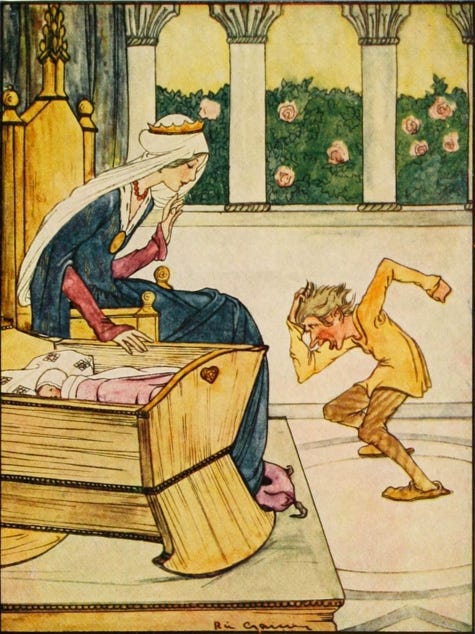
A young woman is sold by her boastful father to their king for her supposed magical gift of being able to spin straw into gold. Of course she can’t actually do that, so in her quiet despair she is approached by a mystical being who offers to help her in exchange for increasingly valuable gifts. Ultimately, her fate is sealed for the better when she bargains her firstborn—who has yet to be conceived—and soon she must undo the verbal contract in order to save her child.
A destitute victim of domestic abuse and forced servitude is granted a night of revelry in the palace by her fairy godmother, but with a warning that in exchange for this disguise and freedom, she must return before midnight. If she doesn’t, everything will fall apart and her harsh truth exposed to the world right in front of those who would certainly abuse her even more.
In both myth and real-life practice, the concept of the Changeling involved the often secretive, but sometimes intentional, swapping of healthy human infants for sickly fairy babes—or the leaving of ailing human offspring in the forest with the understanding and hope that the fae folk would take them in and give them good health in exchange for servitude. In some instances, parents might believe the sick child in the cradle was already a Changeling and therefore the act of leaving them in the woods was a gesture of “yours for mine”, a hope that when the parents returned the next day, their “real” baby would be returned, happy and healthy and unscathed by the temporary abduction.
It seems that no matter which version of each story that comes to mind, if it involves the fairies and fae folk (yes, some would argue there is a difference), a bargain is definitely attached.
So…why?
Why is it that humans can’t seem to have a normal conversation with their magical counterparts which doesn’t require some sort of deal, bargain, or risky exchange of valuables?
It’s fairly broad, too. A name is just as valuable to the fae as a jewel. Information can be traded like currency (and I’m going to argue right now that our contemporary forms of espionage and blackmail probably take notes from Ye Olde Stories). For some species of fae, a symbiotic relationship within a business and/or household is formed by a continuous cycle of, “If you give me cream, sugar, access to supplies, I will help you maintain operations.”
Here’s my theory: the “danger” has less to do with the deal itself and more to do with the trustworthiness of those who make it.
Fae folk are automatically understood to be magical, ethereal, and exist in a way that humans cannot, and never will, fully comprehend. For all our scientific endeavors to explain the universe, we are over-eager to dismiss what cannot be quantified or explained because if we do not possess full knowledge, we cannot begin to find ways to control it. Fairies can dart in and out of visibility, can spin straw into gold and lend cooking pots that always refill with food as long as the user follows the instruction manual. We humans do not like this. We can’t stop it, or dissect it, or develop safeguards against it.
Humans are notoriously deceptive creatures. We love to lie. Even the art of writing literature is an act of fabricating realities that don’t exist and yet…they do…and we can plainly state obvious fallacies without blinking. I can stare you dead in the eye and tell you the sky looks aubergine today while you can clearly see it’s bright blue. You can sit me down and tell me my cat’s turned into a beaver while sipping a latte, and we’ll either both laugh or you’ll laugh while I Google the nearest veterinarian in a panic.
So it makes sense that to fairies and fae folk, humans are equally—and dangerously—unpredictable.
And real talk: we’re pretty selfish.
In the example of Rumpelstiltskin I mentioned earlier, the maiden who needed the imp’s help did not hesitate to bargain away her firstborn child because she had no intention of actually following through with it. Not only did she not have a child at the time of negotiation, she had to have thought there was no way the king would sleep with her to conceive one (he might just kill her anyway), or maybe she was barren, or maybe there was a fleeting idea that her new husband might slay the creature by the hands of his guards.
No matter what, the priority was her self-preservation.
The story tries to explain that she forgot all about the verbal contract with her mysterious helper, but I’ve always found that hard to believe. Even if someone were to get very comfortable in their new status as Queen of the Realm, wouldn’t her husband bring up “that time you turned 80 bales of hay into our retirement plan”? I imagine that would have been a mealtime quip, if not a “pillow talk moment” about how glad he was that her father wasn’t some insane liar he honestly thought he was going to have to execute.
With the fae fully knowing we’re practically guaranteed to put our own interests first, it makes sense that none of them in any of the stories just freely give unconditionally. Even the fairy godmother, who bestows the gift of disguise and freedom for a limited time to Cinderella, places a “you can have this if you do that” stipulation on everything. It’s not as much of a tit-for-tat deal, but it’s still a form of conditional assistance that slips past the generic concept of bargains and deals.
I mean, let’s be honest: Cinderella never asked for anything, but she also never offered anything, from or to the benevolent fairy.
Nothing tangible, I should say. She does technically offer immense gratitude, which I think we can agree still meets (even if barely) the idea of “this for that”. Had she not been the kind of person to recognize the blessings and openly express such gratitude, what are the chances the fairy godmother might have turned that carriage into a pumpkin once Cinderella climbed inside?
Pretty high, I daresay, given all the other stories from around that same region and time period. I mean, heck, the ugly stepsisters mutilated their own feet to get ahead and don’t even get me started on the version with the talking dismembered horse’s head.
With all this in mind, it’s easy to surmise that if I own a magical skillet that will always make perfect bacon and eggs every morning with zero effort—all I have to do it let it sit on the stovetop—and you ask to borrow it because your stove broke, I’m going to want it back.
Eventually. Not right away, because I can tell you’re going through a rough patch and having a hot breakfast can make a difference in your day. You’ll need it for a while.
But I do want it back.
You’re a nice person. We’ve always gotten along as neighbors, even if we haven’t exactly sat and chatted over a pitcher of sweet tea. I don’t know much about you, but I can see you’re a good person worthy of a magical breakfast.
But you’re human. I don’t know you, but I know humans. I’ve seen even the most altruistic of them tell a “white lie” to get out of trouble, and my goodness is your kind “forgetful”.
So before I hand over my special skillet, I’m gonna need something from you to guarantee I’ll be getting it back when I come by for it. Nothing too extravagant or inconvenient, but definitely equal in value so if you decide to steal my skillet, I can keep your valuable possession and either use it or sell it for new magical cookware.
I’ll give you the Pan That Never Quits for your Ferrari. Title, keys, and a full tank of gas.
What?
Do you think self-cooking, self-supplying, self-heating cast iron that’s lightweight and doesn’t burn your hands is cheap or easy to come by? If it were, I’d just send you the Amazon link to buy it yourself.
No, I’m going to need your super-expensive, hard-to-get Tool Of Transportation so I can go live the life of luxury while beep-beeping my way through the Drive-Thru for the breakfast replacement I’m gonna enjoy while you get back on your feet.
And what you’re going to need, even more than me, is to decide what matters the absolute most to you: honoring our agreement and maintaining my trust so we can continue to get along and you can get your Ferrari back…or keeping this enchanted cookware for yourself at the risk of pissing me off.
If you choose to be honorable and trustworthy, I’ll definitely start lending you more cool things you don’t even know I have in my cupboards. Because now I know I can trust you. And because nothing bad has happened when you borrow my stuff, you know you can trust me. I even fix the minor inconveniences in what you lend me as part of our exchange, like that weird squeaking noise the steering wheel used to make.
If you choose to backstab me and steal my skillet, though?
Best believe I’ll be burning donuts in your driveway with your precious car, stealing your wallet to pay for new tires, and laughing when that cursed skillet fills your kitchen with too much bacon and overcooked eggs that will start rotting long before you finally realize there’s no way to turn off the skillet because, to put it colloquially: “Ya done f****d up!”
Deals and bargains are practically the currency of the Otherworld—and exactly why all the problems exist as they do when Song of the Sidhe opens up.
The fascinating part of writing this modern epic fantasy romance/romantasy for me has been finding out just how interwoven and complex the world-build and magic system is…because it’s all based on dark, dangerous deals made with entities no one has any business bargaining with.
It’s not something I actually went into with full intent of that being…well, that. I knew there was one character who definitely made a very dark deal with something/someone they should have known better than to shake hands with. I knew there existed the high probability that someone earlier in their same bloodline did something similar with someone/something else.
What I didn’t expect was the nature of transactional relationships between humans and fairies to practically be a building block of the whole dang series’ universe (and that of its companion urban fantasy series, The White City).
Sure, this family can rule the kingdom and possess all the powers and abilities of every major family group known to their realm practically making them godlike—but they have to tattoo it onto their skin, surrender every and all freedom of personal liberty for the sake of the throne, and sacrifice interpersonal relationships in order to appease the whims of those who gave them the sacred magic.
Of course the war against a demonic horde can end within 24 hours and with minimal effort—but that requires giving away a piece of oneself and the results are too vague to hold “satisfaction guaranteed” status.
Yes, slavery and oppression over a people can end with powerful help—but blood demands blood and lineages will be permanently altered, eternally cursed, and only through the deepest suffering of the weakest link might there arise a “loophole” out of that contract.
Maybe.
In fact, the existence of an entire (and super important) species came to be because one of the primordial entities whose name has been long forgotten in both fiction and the real world made a deal with her own children so they’d be spared from extinction.
(No, it’s not the Tuatha Dé Danann.)
There’s one particular bargain I’m most excited about, and I think once the details emerge and everything hashes out in the books, you’ll agree with my giggly glee over it.
Not because of what the deal is.
But because one side thinks they accomplished getting exactly what they wanted and they’re always going to have the upper hand…
…yet the other side has already broken their end without even knowing it.
And trust me, that’s a good thing.